For Authors
open registration
1st April 2026
Full Paper & Payment
30th June 2026
Notification of Acceptance
26th June 2026
Deadline for Presentation and Poster File
16st September 2026
Seminar event
9-10th October 2026
Abstract Template Article
Full Paper Template
Registration & Submission Article

Author Guideline
- File uploaded in Microsoft Word format
- Papers that are not submitted according to the given schedule will not be refunded for registration and publication fees
- Paper that is declared rejected by the EES IOP Publisher will not be refunded (100% of the fee is retained due to the publisher’s charges)
- The Scopus-indexed proceedings are considered equivalent to a Q3 journal.
- Each author is only allowed to submit a maximum of 2 papers (as author &/or co-author).
- The total pages for 1 paper is a maximum of 8 pages.
- Must use the IOP Publishing EES template.
- Must use reference manager tools (Mendeley).
- Follow the minimum paper structure requirements.
- Similarity is a maximum of 20%.
- There are 2 reviewers who will review one paper.
- The paper in the form of Microsoft Word is submitted through the Google Form link.
- Please submit the metadata of all authors according to the number of authors in the paper.
- The email used should be an institutional email, include the address of the institution, and the ORCID of each author.
- Rejected by the publisher, the publication fee will not be returned to the author.
- Article writing follows the template and guidelines for IOP Conference Series proceedings papers.
Poster Guideline
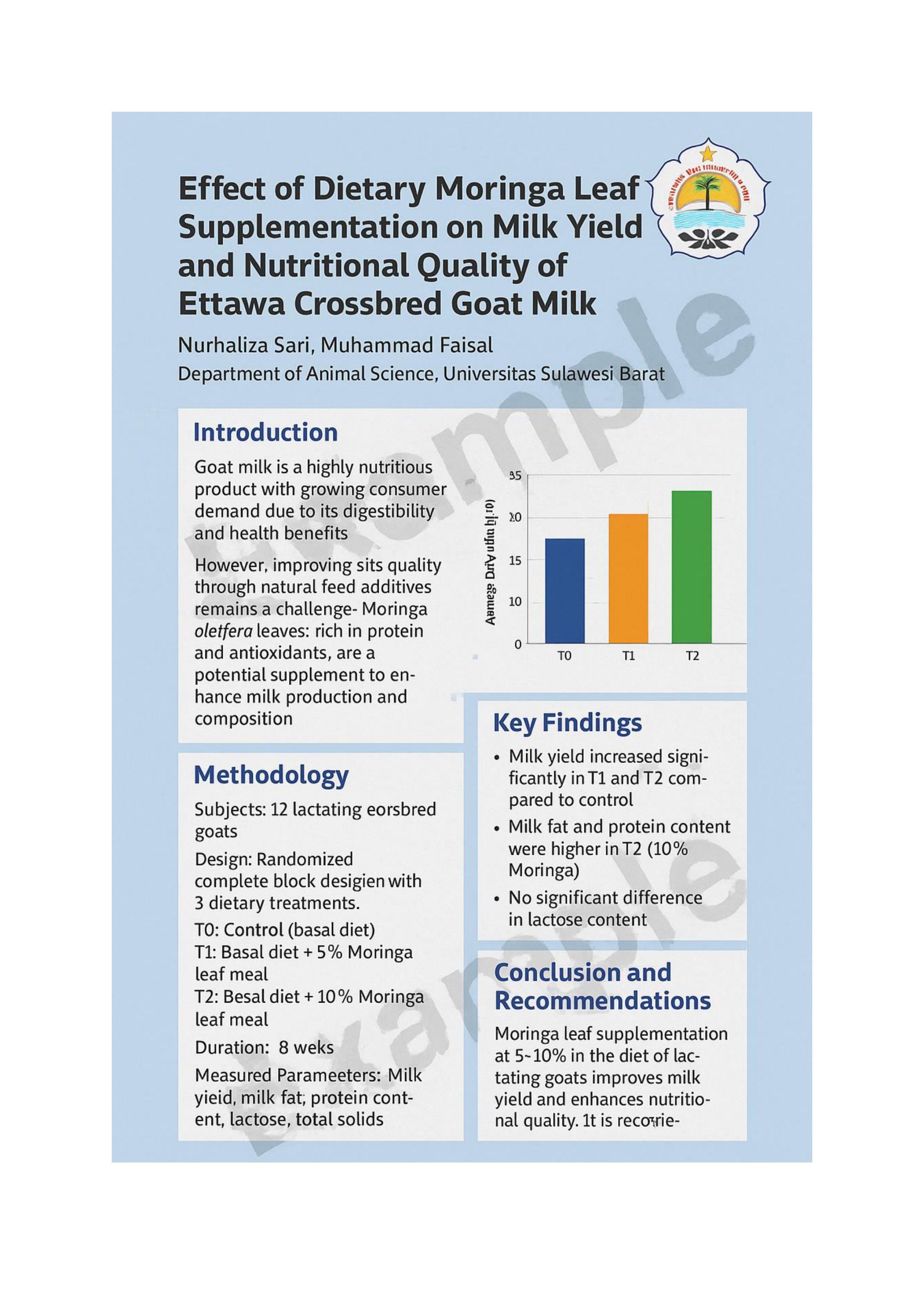
- Each participant must prepare one printed poster measuring 60 × 160 cm, displayed in a vertical orientation (X-Banner format).
- The poster must be clearly legible from a distance of up to 2 meters.
- The poster should include the following sections: (i) Header: Title of the research, name(s) of the author(s), and institutional affiliation(s); (ii) Main content: Comprising Introduction or Abstract, Methodology, Key Research Findings (presented through text, tables, images, photographs, or diagrams), Conclusion and Recommendations, Acknowledgments, and References (optional); and (iii) Footer: May include sponsor or institutional logos, contact details, and the date and duration of the research.
- The layout design of the poster must follow formal and informal balance principles, including: (i) Symmetrical and asymmetrical composition; (ii) Unity in the arrangement of graphical elements, colors, background, and visual flow; ( Effective visual flow that guides the viewer’s eyes through all sections of the poster.
- Posters must be designed using graphic editing software, such as CorelDRAW, Adobe® Photoshop®, Microsoft PowerPoint, Canva, or other equivalent applications. Visual data such as graphs, tables, or photographic documentation may be included.
- Poster authors are required to be present during the designated session as scheduled by the committee, and must be prepared to explain the content of their poster to seminar participants.